
Every winter I end up with at least one cough that lingers for a week after the cold itself is gone. That irritating, won’t-quit cough that’s not bad enough to see a doctor but annoying enough to keep me up at night. Over the years I’ve narrowed down which teas actually do something versus which ones just provide warm liquid comfort. There’s overlap there — warm liquid comfort isn’t nothing when you’re sick — but some teas have genuine pharmacological effects on coughs.
This article contains affiliate links to teas we recommend. If you buy through them, we may earn a small commission at no extra cost to you. We only link to brands we’d drink ourselves. Full disclosure.
Here’s the practical answer: for a wet, productive cough (the mucus-y kind), ginger tea with honey is the best combination. For a dry, scratchy cough, peppermint tea works better because menthol suppresses the cough reflex. For a sore throat with a cough, licorice root tea coats and soothes the irritated tissue. If the throat pain is the main complaint rather than the cough, our guide to tea for a sore throat goes deeper on what actually coats and soothes. Let me break down why.
Ginger Tea: The All-Rounder
Ginger is my first reach when a cough shows up, and the research backs that instinct. The gingerols and shogaols in ginger root have documented anti-inflammatory and bronchodilatory effects — meaning they reduce inflammation in the airways and help relax the smooth muscles around them. A 2013 study in the American Journal of Respiratory Cell and Molecular Biology found that specific ginger compounds helped relax airway smooth muscle cells, which is relevant for coughs caused by bronchial constriction.
Ginger’s anti-nausea properties are better studied, but its respiratory benefits are supported by enough research to take seriously. In traditional medicine systems from Ayurveda to traditional Chinese medicine, ginger has been used for respiratory complaints for centuries — and while tradition alone doesn’t prove efficacy, it’s encouraging when the clinical research starts confirming what practitioners have observed.
The best method for a cough is to simmer 2 inches of sliced fresh ginger in water for 15 minutes, then add a tablespoon of raw honey and a squeeze of lemon after you take it off the heat. The honey matters here — it’s not just for taste. A 2020 systematic review in BMJ Evidence-Based Medicine analyzed 14 studies and found that honey was more effective than usual care for reducing cough frequency and severity, particularly in upper respiratory infections. Adding honey to ginger gives you anti-inflammatory action from the ginger plus the demulcent (coating, soothing) effect of the honey.
Peppermint Tea: Best for Dry Coughs
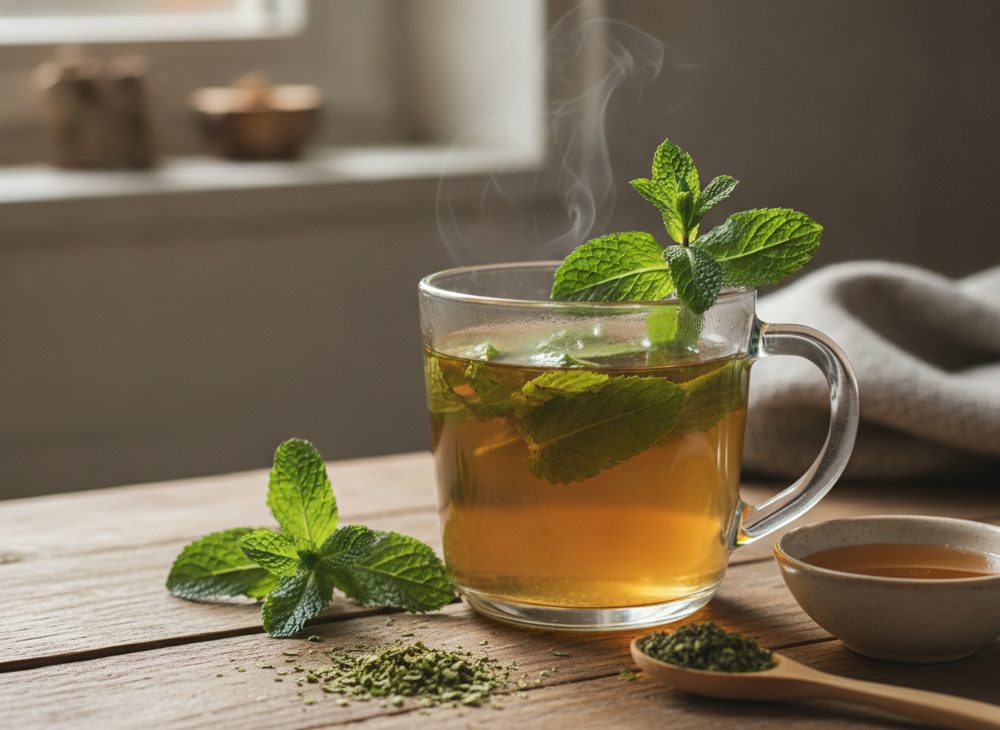
Peppermint works through menthol, which acts as a natural decongestant and cough suppressant. Menthol activates cold-sensitive receptors in the airways, which produces a cooling sensation that can reduce the urge to cough. It also has mild analgesic (pain-relieving) effects on sore throat tissue.
Peppermint tea is particularly good for dry, hacking coughs — the kind where there’s no mucus to bring up and the cough itself is just irritation. The menthol temporarily numbs the tickle in your throat that triggers the cough reflex. I brew it strong (two bags or a generous tablespoon of dried peppermint, steeped 7 minutes covered) and breathe in the steam before drinking. The steam inhalation and the tea itself work together.
One caveat: if you have acid reflux, peppermint can make that worse even while it helps your cough. Menthol relaxes the lower esophageal sphincter. If you’re coughing and dealing with reflux at the same time — which is common since reflux itself can cause a chronic cough — ginger is a safer choice. I’ve covered the full relationship between tea and heartburn if you’re navigating both issues.
Licorice Root Tea: The Throat Coater
Licorice root contains glycyrrhizin and flavonoids that have demonstrated expectorant and demulcent properties — meaning it helps loosen mucus and coats irritated throat tissue with a soothing film. It’s particularly good for that raw, sandpaper feeling in your throat that comes with persistent coughing.
A 2015 study in Anesthesia & Analgesia found that gargling with licorice solution before surgery reduced postoperative sore throat by 50%. While gargling isn’t the same as sipping tea, the soothing mechanism is similar — the compounds coat the tissue and reduce irritation.
Brew licorice root tea by steeping a tablespoon of dried root in just-boiled water for 10 minutes. It has a naturally sweet taste (glycyrrhizin is 50 times sweeter than sugar), so you probably won’t need honey. A word of caution: don’t drink licorice root tea daily for extended periods. Glycyrrhizin can cause potassium depletion and blood pressure elevation with chronic heavy use. For a week or two while you’re fighting a cough, it’s fine. As a daily habit, look for DGL (deglycyrrhizinated) versions instead.
Thyme Tea: The Traditional European Remedy
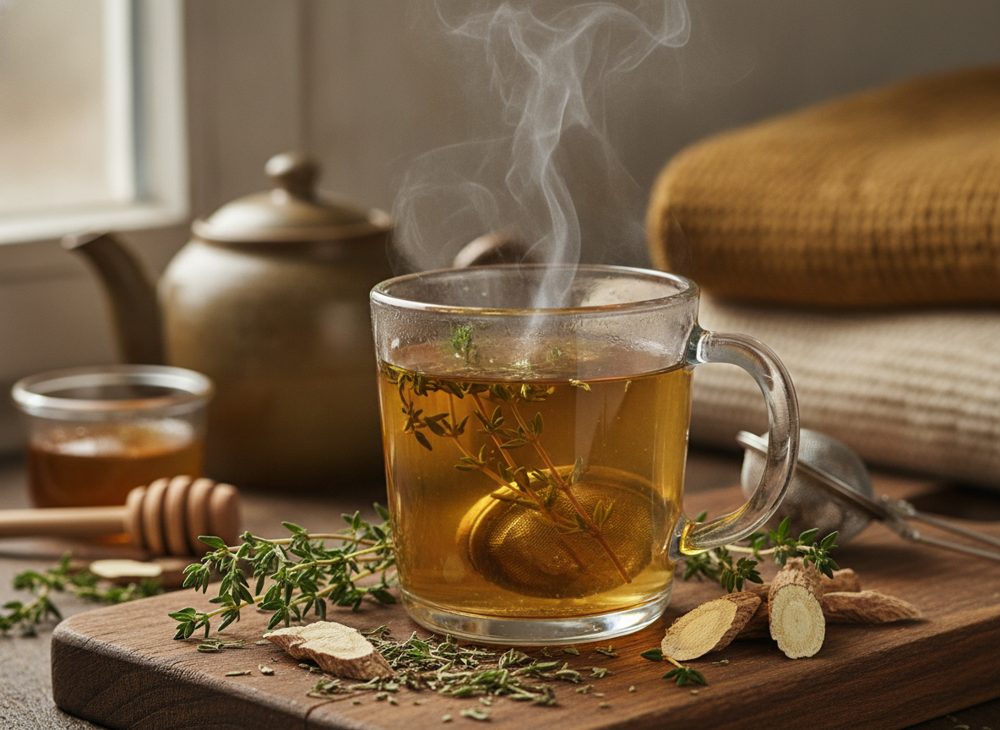
Thyme tea is widely used as a cough remedy in German and Swiss herbal medicine, and Germany’s Commission E (their equivalent of the FDA for herbal medicines) has officially approved thyme for treating bronchitis and upper respiratory infections. The active compounds — thymol and carvacrol — have antispasmodic effects on bronchial muscles and antimicrobial properties.
A clinical trial published in Drug Research found that a thyme-ivy combination reduced coughing fits by 68% over 11 days in patients with acute bronchitis. Thyme on its own is less studied than the combination formulas, but the traditional evidence and the pharmacological profile of thymol support its use.
To make thyme tea, steep 2 teaspoons of fresh thyme (or 1 teaspoon dried) in boiling water for 10 minutes. It tastes herbaceous and slightly savory — more like something you’d cook with than a typical tea. Honey and lemon help make it more drinkable. Honestly, it’s not my favorite-tasting option, but when I have a bad bronchial cough, I reach for it because it seems to work on the spasmodic element better than the others.
Honey-Lemon: Simple and Effective
Sometimes the simplest approach works. Hot water with honey and lemon isn’t technically a “tea,” but it belongs in this conversation because it’s what most people already reach for. The honey coats the throat and has genuine cough-suppressing properties (that BMJ review I mentioned found it outperformed diphenhydramine in some studies). The lemon provides vitamin C and a mild astringent effect that can reduce swelling in throat tissue. The hot water thins mucus and soothes irritation.
I use honey-lemon as a base and add one of the herbal teas above for extra benefit. Ginger-honey-lemon is my standard sick-day drink. If you’re also trying to support your immune system while fighting off a cold, consider adding teas with high antioxidant content — though the immune-boosting angle is more about long-term support than acute cough relief.
When to Stop Making Tea and See a Doctor
Tea is great for managing common coughs from colds, flu, and minor respiratory infections. But some coughs need medical attention:
- Coughing up blood or rust-colored mucus
- A cough lasting more than three weeks without improvement
- Difficulty breathing, wheezing, or chest tightness
- High fever (above 103F/39.4C) that doesn’t respond to medication
- A cough that started after choking on food or liquid
- Unexplained weight loss alongside a persistent cough
Chronic coughs can also be caused by acid reflux, asthma, ACE inhibitor medications, or post-nasal drip — none of which are going to be fixed by herbal tea alone. If your cough persists, get it checked out. Tea helps manage symptoms, but it doesn’t treat underlying conditions.
For the anti-inflammatory properties that help with coughs caused by airway inflammation, ginger and thyme are your strongest options. For pure soothing relief, licorice root and honey are hard to beat. Match the tea to the type of cough, and you’ll get more benefit than reaching for the same thing every time.
Frequently Asked Questions
Can I drink cough tea while taking cough medicine?
For most OTC cough medications (dextromethorphan, guaifenesin), herbal teas are fine to use alongside them. The mechanisms don’t conflict. The one exception is licorice root — if you’re taking medications affected by potassium levels (certain heart medications, diuretics), check with your pharmacist before adding licorice tea. Honey should not be given to children under one year old, regardless of what tea it’s in.
How many cups of tea should I drink when I have a cough?
Three to four cups spread throughout the day is a reasonable amount. Beyond the active herbal compounds, the hydration itself helps thin mucus and keep your throat moist. Don’t force down more than is comfortable — the goal is steady intake, not volume. Spacing cups every 3-4 hours maintains a more consistent effect than drinking it all at once.
Is green tea good for a cough?
Green tea has antioxidant and mild anti-inflammatory properties, but it’s not specifically effective for coughs the way ginger, peppermint, or thyme are. The caffeine in green tea can also be dehydrating, which is counterproductive when you’re sick. If you want the antioxidant benefit, drink it earlier in the day and use herbal cough teas in the evening and before bed.
Does the temperature of the tea matter for cough relief?
Warm tea is better than hot or cold for coughs. Very hot liquid can irritate already-inflamed throat tissue, while cold drinks can cause throat muscles to tighten. Warm (not scalding) tea maximizes the soothing effect and allows you to breathe in the steam, which helps with congestion. For peppermint tea specifically, the menthol vapors from warm steam provide additional decongestant benefit before the tea even reaches your throat.
Next time a cough settles in, skip the generic cough drops and put the kettle on instead. Match the tea to the cough — ginger with honey for the wet stuff, peppermint for dry and scratchy, licorice root when your throat feels raw. It won’t replace medical treatment for anything serious, but for the everyday coughs that linger after a cold, a well-chosen tea does more than most people expect.